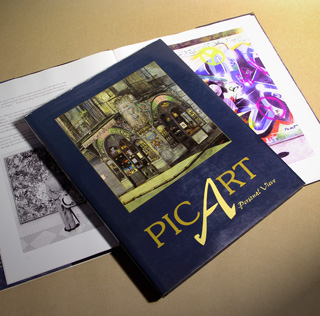
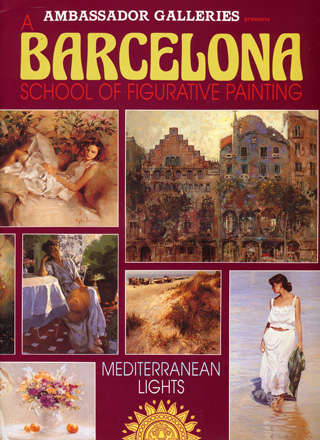
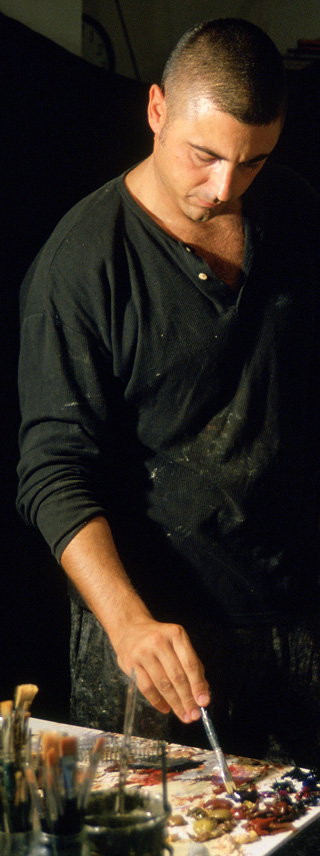
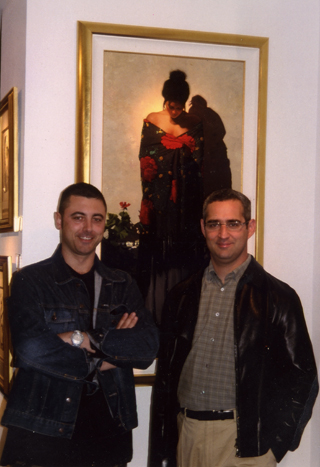
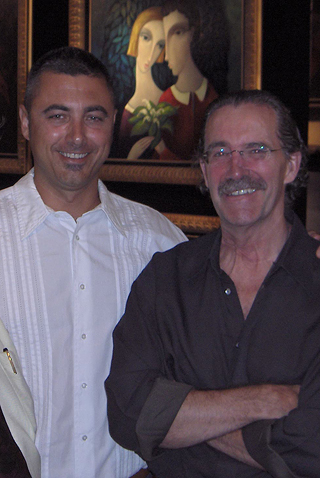
I have known Gabriel Picart for many years. When he told me that this book was to be produced*, I asked him to allow me to make some remarks about his work to give my "personal view."
Gabriel (Gab to me) has been a personal friend and a business associate for many years now; I've known him almost from the beginning of his career, introducing his work to the American market. While I am not a professional art critic, I believe I have special insight into him and his work that will be of interest to collectors.
Biographical Details
He was born in the beautiful Mediterranean city of Barcelona - for anyone not familiar with this city of ancient culture I recommend Robert Hughes' masterful book titled "Barcelona". Barcelona is important to Picart's history because it is a city steeped in deep and rich traditions of artistic achievement - it was, for example, Picasso's first stop on his road to fame.
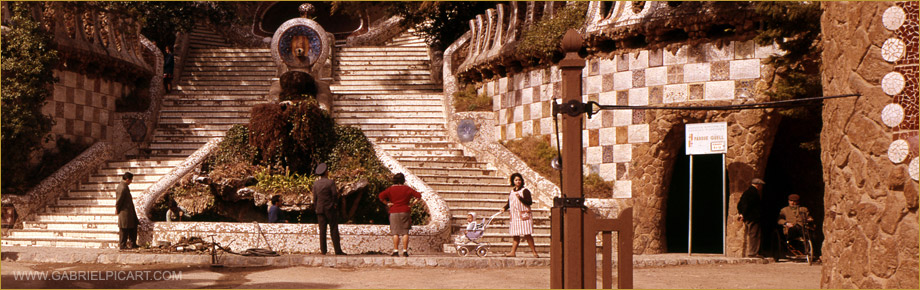
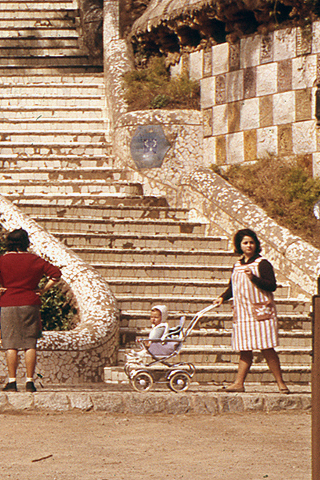
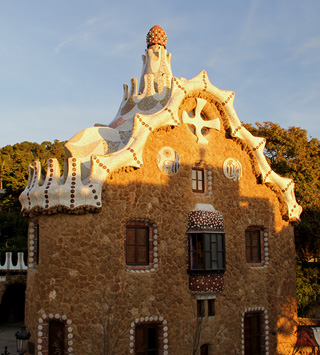
Since 1962, the year Picart was born, he has spent most of his life in the same neighborhood, and, as fate would have it for a soon-to-be artist, this quarter of the city was perhaps its most famous. It is the quarter where the world famous Park Güell is located, and Gab's family came to live in a big house adjacent to the Park's main gate.
The Park is one of the most famous in the world. It is also one of Barcelona's most important tourist attractions. Created by the great Catalan architect Antoni Gaudi,
the Park Güell was the realization of his utopian vision - he designed the Park at the beginning of the last century as a new Arcadia, a Paradise on earth.
Appropriately, it would become that for Gabriel.
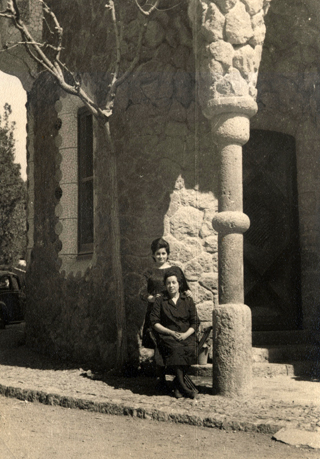
For over fifty years, Gabriel's family lived in the concierge's pavilion at the right of the main entrance of the park. The original porter, his name Alfons Saumell, an old friend of Gabriel's great-grandfather, lived alone in this huge house until he became disabled. As chance would have it, Gab's grandmother Filomena sold candy and sundries next to the front door of the pavilion, and the porter kept her wares for her overnight in the big house. One day, Alfons
invited her and her family to live with him, and when he became
too ill to execute his duties, Gab's grandmother took over the
job of gatekeeper to the Park. Thus Gabriel was born and spent
his childhood in that historically glorious pavilion Gaudi had
designed to emulate the witch's house in Brothers Grimm's
fairytale "Hansel and Gretel".
The entire Park became Gabriel's playground - it is no wonder that within an artistic milieu such as this he would soon develop an interest in art.
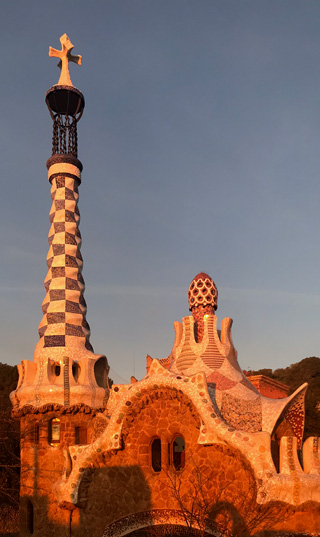
Picart always had a pencil in his hand; by the time he was a teenager, his parents had rented the other pavilion on the opposite side of the main gate- for $5.00 per month! This building, with its oddly shaped tower bearing on its top a double cross (later to become one of Barcelona's main cultural symbols) had been for many years Gaudi's workshop. In the 1980s, both pavilions and the Park Güell itself were designated by UNESCO as part of "Mankind's Heritage". This pavilion was all his to work in as he chose.
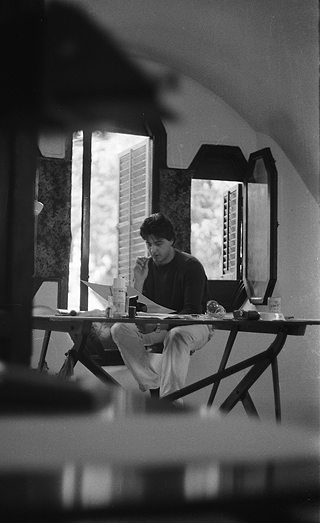
In the very same room that Gaudi executed his designs, Picart set up his first studio. He says that he felt Gaudi's ghost hovering over his shoulder. Gab soon became so addicted to painting that he gave up
studying architecture.
"I just cannot overemphasize the importance that this place and its unique universe of intricate and fascinating forms of delirium and poetry has had on me," Gabriel has often remarked. "It has left an indelible impression on my soul forever.
The Young Artist
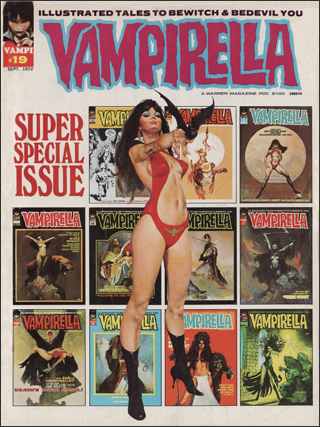
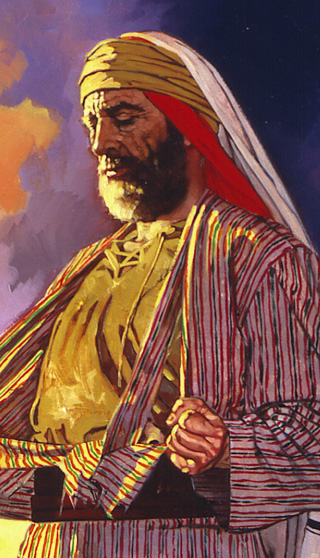
Fortune smiled on Gabriel. Not long after he had made the decision to become a professional artist, he had the good luck to meet the famous illustrator Enric Torres (who I also represented, though I did not know Gabriel at the time). Enric invited Gabriel to visit the studio he shared with the best ink and charcoal illustrator in Spain, one of the creators of the incomparable Vampirella, Pepe Gonzalez. Pepe was one of the world's foremost comic artists - an acknowledged master of the art of drawing, rendering and composition.
By the age of twenty Picart was on his way. The young Gabriel became the third member of the studio. With the mentoring of these two great artists, Gabriel soon learned the secrets of drawing the human figure, as well as techniques of mixing paints, preparing a canvas, rendering, and the technical application of medium to surface.
"I was the luckiest art student ever," Gabriel says. "An old Parisian style free-tuition atelier, and two masters of my own. How could it have been better?"
Picart's career as an illustrator blossomed; he worked on commissions throughout Europe. In 1985, I met Gabriel on his first trip to New York City. He came on a visit with Enric and the incomparable titan of Spanish illustration, Sanjulian, who I also represented. Both had recognized Gabriel's particular genius and told me that if I were smart I would represent this "boy wonder." I did not hesitate. My company, SI International, was noted for its ability to select the best European artists. Our collaboration began, and to my great pleasure we have been together ever since.
Picart quickly won assignments (no surprise there!) from all the major publishing houses in America and Canada. He worked as well for advertising agencies, graphic design firms and catalogue houses. Art directors clamored for his paintings because he brought a fine art style to his representational illustrations. Clients loved his paintings for their simple elegance. He was, in short, the best commercial artist of his kind that I have ever represented.
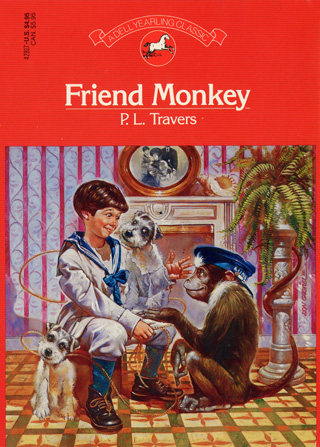
From the very beginning of his career here, he was being compared to none other than Norman Rockwell - Gabriel's great hero. When the original painting of his first commissioned piece for the US market was sent to be printed (Friend Monkey, Dell Publishing, 1986), the printer thought that it was an original Rockwell. Hearing this, Gabriel was ecstatic:
"Norman Rockwell was a great master painter who devoted his life to work for publishing and advertising companies as many Renaissance artists did for Popes." Picart's painting "The Connoisseur" is a tribute to Rockwell.
Fine art collectors are aware of the importance of Picart's training as an illustrator. The demands are at times almost super-human because the challenges are both technical and aesthetic. Besides being able to draw, render and paint, the successful illustrator must be able to communicate directly to the viewer. This Gab notes is absolutely essential to create a successful illustration.
Picart maintains "most great art was produced as commercial assignments. During this last century, for example, some of the best figurative paintings have been made in illustration art, just as some of the best descriptive music has been created for movie sound tracks."
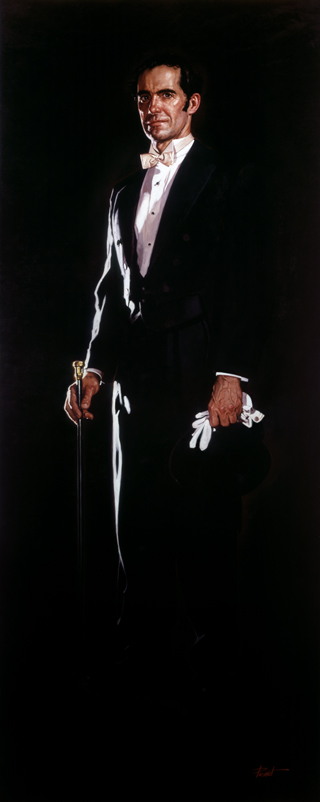
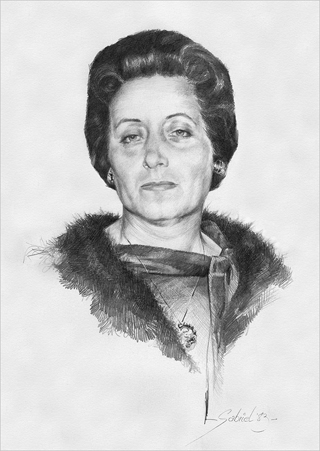
For his own part, Picart chose to master the use of oils in creating his illustrations, in contrast to some of the faster and easier mediums and techniques available, always with the goal in mind of parlaying this technical acumen into the painting of fine art. Gabriel was successful as a commercial illustrator, accepting a variety of commissions from genre illustrations to portraits (I commissioned him for a full length portrait of myself).
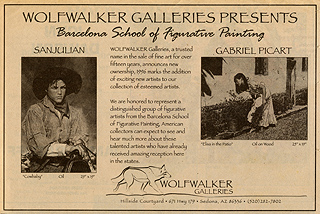
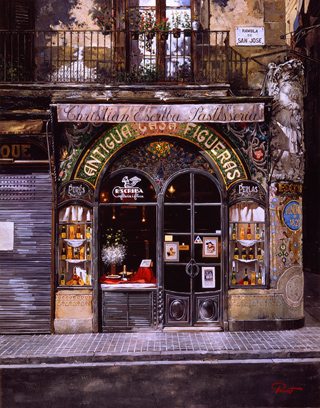
Though I've never been certain how, Picart found time to do fine art paintings and began showing his work at the Sala Parés in Barcelona - a very prestigious gallery. In 1996, he had his first show (complete with attending paparazzi) at the WolfWalker Gallery in Sedona, Arizona. This was quickly followed by his participation in a group show of Catalan artists at Ambassador Gallery in New York. He was among some of the leading contemporary figurative painters working in Spain at that time, and his painting “Antigua Casa Figueras” was evaluated by many collectors. "We could have sold it a dozen times," Elie Miner, the owner of Ambassador remarked.
Gabriel Picart was on his way as a studio painter of fine art. Galleries throughout the US have asked to carry his pictures. As a result, he no longer accepts illustration commissions; he paints full time.
A Renaissance Man
Picart's first love is painting. But it is not his only love, as he is a Renaissance man. Gab feels a deep connection to Leonardo, Vivant Denon and Rusiñol (the great Catalan master) to name a few. He most admirers painters who were at the same time writers, engineers, architects - and, most of all, storytellers.
Picart reads widely in philosophy and history, and he loves to write - he is currently working on a multi-media project for kids based on a children's story he has written. Naturally, this project involves teaching art to kids, and in concept and originality it is, in my opinion, nothing short of brilliant.
He says that the more he knows about the abundance of life, the more he knows about painting. His personal philosophy in that all arts and human sciences are interconnected. For example, we were talking about singing while tasting an exquisite Penedés wine. I remarked that too often a singer makes the mistake of starting a song too powerfully. He readily agreed. "Painters shouldn't use black and white in a painting too soon," he said, making the connection between painting and singing, "for there is nothing lighter or darker than these. A concept for making a beautiful song is the same concept for making a beautiful painting. Inner rules are the same for all aesthetic undertakings."
We've often spoken of the great gift that is given to every painter - a gift that is given freely, that is unearned - the gift of being able to paint. Because of his belief in this gift, he works on the ethical principle that it is the responsibility of every artist to give back to society. Gabriel has, several times.
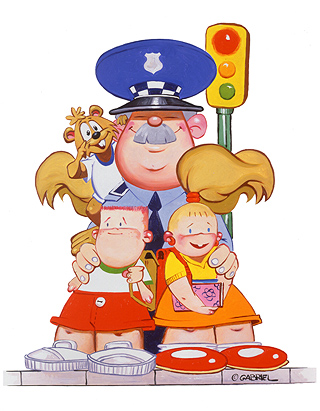
The Government of Barcelona has recognized his contribution to children's traffic education programs, and the Spanish Red Cross commended him for his wonderful charcoal series that he made at seventeen to teach how to give first aid properly.
A Realist Painter
Wilhelm Worringer defined Abstract Art as characteristic of Germanic and Northern cultures, developed in a hostile environment. Figurative painting on the other hand belongs to classical Mediterranean civilizations, and this means an identification with environmental elements and objects. Picart is adamantly a figurative painter. He was born on the northwest Mediterranean coast, a beautiful and kind environment: "how could I refuse to try to reflect the beautiful things all around me in my paintings?" he remarked once as we were traveling along the Costa Brava, the gorgeous cost north of Barcelona.
As a consequence of living in a place designed one hundred years ago, Gabriel developed a deep interest in everything that pertains to the aesthetics of the fin de siècle period. Of special interest to him is the period from mid-nineteenth century to the beginning of the twentieth.
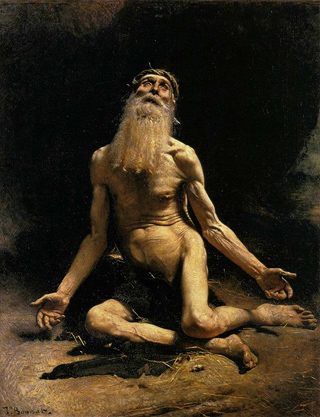
"I consider myself within the tradition of painters such as Alma-Tadema, Bonnat, Leighton, Gerome, Bouguereau, Sargent, Fortuny and Water-House. It is unfortunate that all of them have been overlooked by latter day critics who relegated figurative artists to the dismissive category of 'the merely decorative.' Of course, this is now changing rapidly with the current resurgence of representational and objectivist art. For one thing is certain about these artists: in the technique of drawing and painting they were second to none."
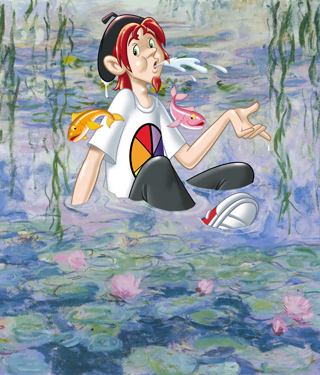
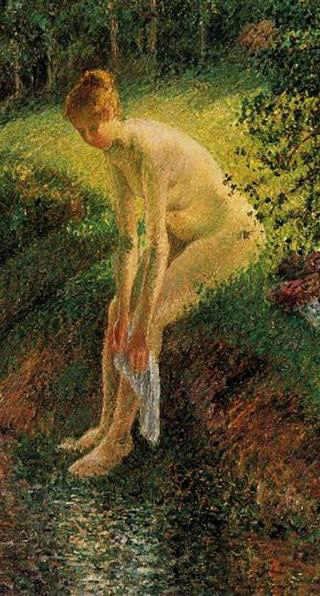
Though he paints realistically, Gabriel respects all forms of painting. He believes that "Realism" can and must take advantage of all the other "isms" in art. Representational painting benefits from any advances made in non-representational manners of expression. "This is true," Picart argues, "whether we are talking about Geometric Abstraction or Impressionism, for example. From Geometric Abstraction, realism benefits from what abstraction has learned about composition. From Impressionism, realistic paintings benefit from the influence impressionism has provided concerning the relationship between environmental light and local color of subjects, and how the lines between the two are often blurred. This now makes possible a more accurate treatment of light. And as a paradoxical consequence, makes it more realist."
However, the main influence in his love of figurative art as realistic interpretation is the precept of communication.
"Ancient Egyptians used the same word SESH to describe Paint and Write, as both were for them the same thing: communication. This is true for me too." Of all the pictorial languages, realism, including surrealism, is the best form of communication for Gabriel.
While his work is representational, it is not photographic realism. All of his paintings are in a pure realistic style, not hyper-realistic, and the imitation of reality he creates is only apparent. For Gabriel, this is where the true magic in painting is to be found.
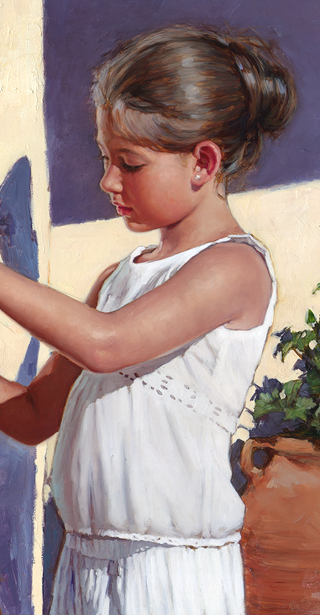
Picart captures the way natural light reveals details that the untrained eye does not notice. His intention in this is to make the viewer look anew at how parts create but do not compete with the whole. "I particularly love painting details," he says. "However, they should never be rendered so exactly that they distract the viewer from the main focus of a painting. Details should support the main elements of a pictorial composition, not compete with them."
He strives to achieve a balance between line, color and texture - in that order of importance. The line, or drawing, is the main pillar that supports the pictorial work. This is its architecture if you will. Gab is a consummate drawer (back to his training as an illustrator) and his line is always personal. His drafting and rendering create a new reality rather than simply recreating an existing one. He does not seek to mimic. Rather, he seeks to parallel what he sees on a higher level.
Picart prefers to work with strong and contrasting colors; he likes subtle shading (look at his skin tones). "I like to use almost primary colors sometimes. But I do not intend for them to dominate the picture, as too often happens in contemporary figurative painting."
For texture, he likes to leave his brushstrokes clearly visible, sometimes solidly applied with a palette knife. He works in the time-consuming manner of the old masters, so rare in today's painting scene. "I love the addition of very thick impastos whenever possible, but only when possible, otherwise the use of impasto becomes a cheap trick used to fool the public into thinking a picture is important. Too much paint in fact can cheat one of the most important qualities of oils: its transparency. The old masters frequently added thin layers of transparent oil colors to give the illusion of depth and light."
Collectors are attracted to Picart's technique of painting on wood panel instead of canvas. Painting on wood panel has a long and venerable tradition, much older than painting on canvas. "The truth is that I've made many paintings on canvas," he says, "and it is an excellent support for oils. But panel allows me to make more preliminary work and always looks flat and stiff, instead of canvas that must be strengthened regularly."
Picart is a studio painter. His works are too intensely laborious to be executed
'en plein aire'. Natural light changes very quickly and this means that it is impossible to work on the same painting for a sustained period of time.
"Painters such as Renoir who were most concerned with natural light made some of their most celebrated paintings in this way," Gabriel observes. There is an added benefit: by working in his studio, he frees his imagination from the tyranny of the moment and allows his personal impressions and memories to suffuse his compositional and color choices. This is an unconscious process that allows for an idealization of his subject matter, an idealization that is idiosyncratically personal.
Subject Matter
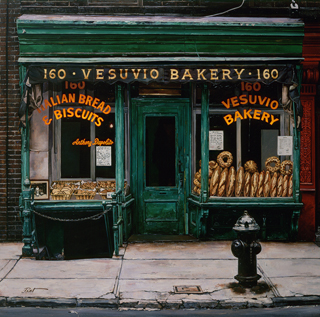
Picart is interested in painting a variety of subjects, although he first became known for his dimensional façade pictures of Barcelona and romantic scenes of picturesque Venice. "I love painting facades of Barcelona that are known throughout the world," he says. The smaller shops that he loves to paint are a counterpoint to contemporary buildings that are anything but human in scale. "Around these shops there is a kind of modern 'agora' where people can meet and socialize. In my painting of facades, I want the viewer to be able to (almost) get inside."
He does not seek to be original for the sake of originality, a trait he feels is all too common in much of contemporary art. He paints what he feels like painting. Sometimes this means painting the same subject more than once. When he repeats a subject his intention is to learn and to improve, not to copy a previous painting because it was successful. "I just could not," he proclaims. "My idea of Painters' Hell is to repeat over and over again the same painting." Instead, repetition of subject matter is for him a technical and conceptual challenge.
Although most of the shops he paints are from Barcelona, he just cannot help painting building facades from other places like New York City. "I think these buildings say more about the people who live there than all the details in a tourist's guide book," he jests. He is sentimental and metaphorical in this regard: "I especially love those old shops with their many layers of paint overlapping one another like a charming old lady who puts on too much make up to disguise the fact that she has seen better days. The thickness of the paint lends a smoothness and warmth to the cold feeling of the hard metal, and softens the sharpness of the wooden borders. No matter if it is a bakery or a human soul, the effects of time are always the same." He laughs in observing this - mainly at himself.
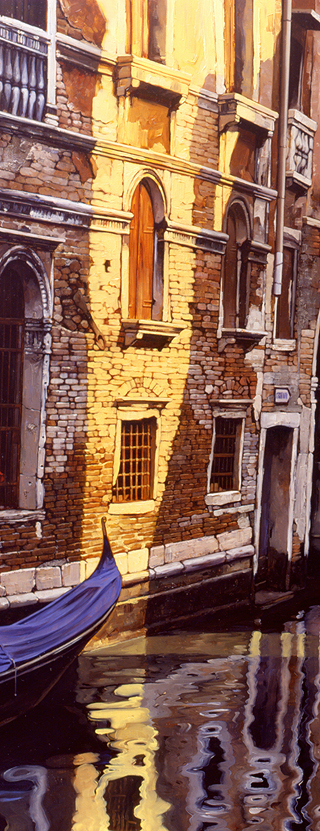
Venice is one of the most recurrent subjects in landscape and façade paintings. He says: "I love painting Venice. All that a painter may dream about in a painting subject is found there. First the line, the fascinating and different lines of its architecture, the ornate baroque buildings and the renaissance palaces, the gothic style mixed with oriental cupolas... Second, the color: facades of all colors, one next to the other almost as if in a wonderful competition with each other. Pale and richly colored sit side-by-side. And third the texture: the perfect setting to add thick impasto! Layers of old paint overlay one another, cracking so as to make plainly visible the humble bricks, which contrast so dramatically with the rich marbles with which they have been juxtaposed. And all of this is multiplied without end. As the water reflects and distorts the architectural lines, it makes the colors shine even more, and the thick impasto competes with its smooth, glassy surface."
After decades of neglect and derision, painting the human form is once again respected and in demand. Throughout most of the last century, the human figure was transmogrified either by way of abstraction of distortion. Classical figurative painting was pejoratively dismissed as either academic or hopelessly decorative. Draftsmanship was no longer considered essential to a work of genius (many overlooked the fact that Picasso was a master draftsman!). Indeed, it is an open secret that in the last fifty years drawing has ceased to be taught in most art academies. Picart's ability to draw is therefore rare. Typically, he positions this via music:
"I've been told by musicians that the difficulty of Mozart's interpretation is that his music is absolutely transparent, and any small mistake in the execution is easily detectable. Just the same happens with the making of realistic paintings, as they are absolutely transparent to the viewer too. Thus, when they contain human figures, which pose the most difficult challenge that painting has to offer, the road to success becomes very demanding. The human figure is the highest point of achievement in art. For this reason, it is a must for any artist willing to face this challenge. It is a MUST if he wants to make progress in his technique."
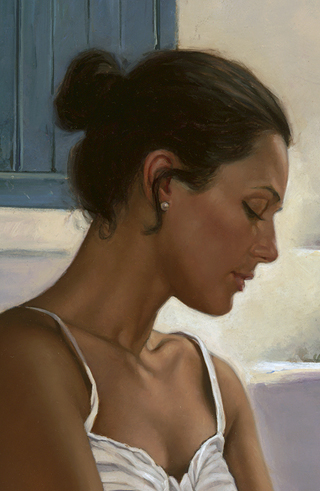
Picart's beautiful wife, Rosa, often serves as his model. "Rosa's beauty has a quality that I appreciate from a painter's point of view. Her features, like those of Alma-Tadema's models (also his wife mostly) or those of Water-House, tend more to an academic ideal than to the contours and shapes of a specific person. It is a sublime accomplishment to achieve this academic ideal because it means that I have escaped the trap of figurative painters: making the painting of the model look like a portrait of the model."
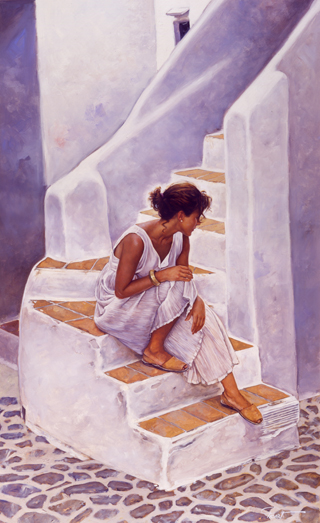
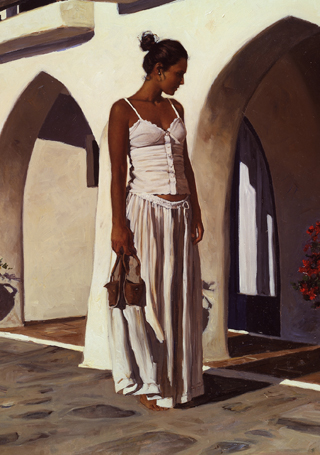
In the fabled paradise of Minorca (part of the Balearic chain of islands off the coast of Catalonia), Gabriel posed Rosa to create a dynamic series of "minimalist" figurative paintings that have won praise for their clarity of light and simplicity of composition. "When I first visited Minorca, I could not resist the temptation to make a series of paintings based on its architectural details as the background against which I posed Rosa." He always places great importance on pictorial detail: "I do not like the fully colored shapeless backgrounds that make figures look like they are in some kind of psychedelic limbo," he jokes.
Binibeca is the name of the town in Minorca where he has done most of his sketching. It is a fisherman's town full of old-world charm. "Its wavy and odd shapes remind me of those of Gaudi," Gabriel explains, "except that they are simpler and whiter. I would go so far as to say that the buildings are fully white." The curves of Binibeca's architectural elements lend a movement to the composition that Gabriel finds interesting. His 'minimalist' paintings are much in demand. This reflects the renewed interest in simplicity in figurative painting.
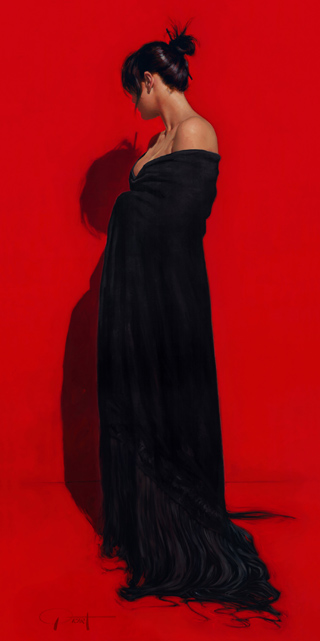
In addition, the Minorcan paintings are a tribute to Mediterranean woman. The tanned olive skin of his figures, sometimes in shadow to darken them even more, look like true living bronze statues against the white walls. They are reminiscent of the women from Cordoba painted by Romero de Torres. Gallerist, Rowland Weinstein, asked him to paint women wearing the famous Mantón de Manila, the beautifully colored shawls that have become emblematic of feminine elegance in Spain. This represented a new challenge for Gabriel. "To be honest, I never thought of making a Mantón de Manila style painting. However, when Rowland asked me if I'd be willing to do some for his gallery in San Francisco, I was delighted because this type of paintings are classical in terms of Spanish figurative art."
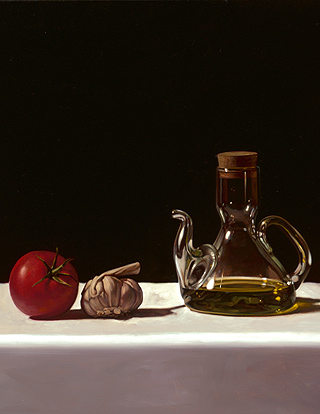
Picart also has added still-life to his repertoire. "The good thing about still-life is that I am in complete control. I do not depend on a model or on a beautiful landscape. I choose the subjects to paint and I place them where I need them. I decide how to light them. I create it all. It's great fun."
Some have observed that "no matter what Picart paints it is a still life." Gabriel fully agrees. This observation explains the unique look of all of Gab's work, no matter what the subject. Gabriel attributes this to the enormous influence that architecture (Gaudi again!) has had on his painting life. It forces him to arrange lines and shapes in architectural schemata. From small fruits to human figures or boats, from building facades to the canals of Venice, Gabriel follows, almost magically it seems, the invisible geometrical guidelines that result in harmony.
All of his paintings share a common quality, despite the subject. In a century, Picart's paintings will still look contemporary. Gabriel's paintings go beyond current trends and fads in painting styles popular today. He does not intend his paintings to be fashionable, although they are extremely elegant. His intention is for them to endure the test of time. In this way, a Picart painting is a classic painting.
Epilogue
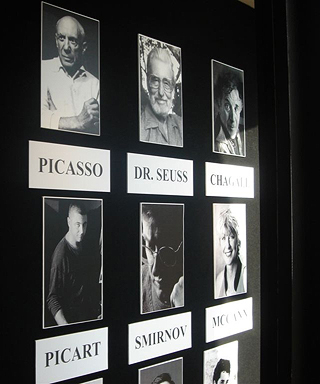
Picart is an artist to watch; his work is destined for museum collections. His paintings are time consuming and therefore he does not produce a lot, which means that the number of galleries that can carry his work is limited. Picart's paintings have attracted special attention of noteworthy critics and collectors, and they are on display at some of the most recognized galleries in the US, were they hang with titans of the brush, such as Chagall, Miró, Dalí and Picasso, and some of the leading contemporary art found in the world today. At Anderson Galleries in particular, his paintings have hung with those of Bouguereau, one of Gabriel’s painting heroes. This is a tribute to his exceptional talent.
Herb Spiers — New York, October 2000.

Herb Spiers
(1945-2011) was an art dealer for over thirty years. He earned a Ph.D. in
Philosophy and wrote extensively on the arts. He co-authored the statement “We Demand,” presented at the first public gay liberation demonstration in Canada, and was a founding member of ACT UP, New York. Herb Spiers was also a founding member of the gay liberation periodical The Body Politic, for which he wrote reviews and articles.
(*) "This book was published in 2001. It was only five years after I started
working as a fine art painter only. Although some of my statements and opinions
should be qualified, or, alas!, revised even, I still think that it is an
excellent testimony on my art career till that moment, and about myself."
—
Gabriel Picart